Save time, stay self directed.
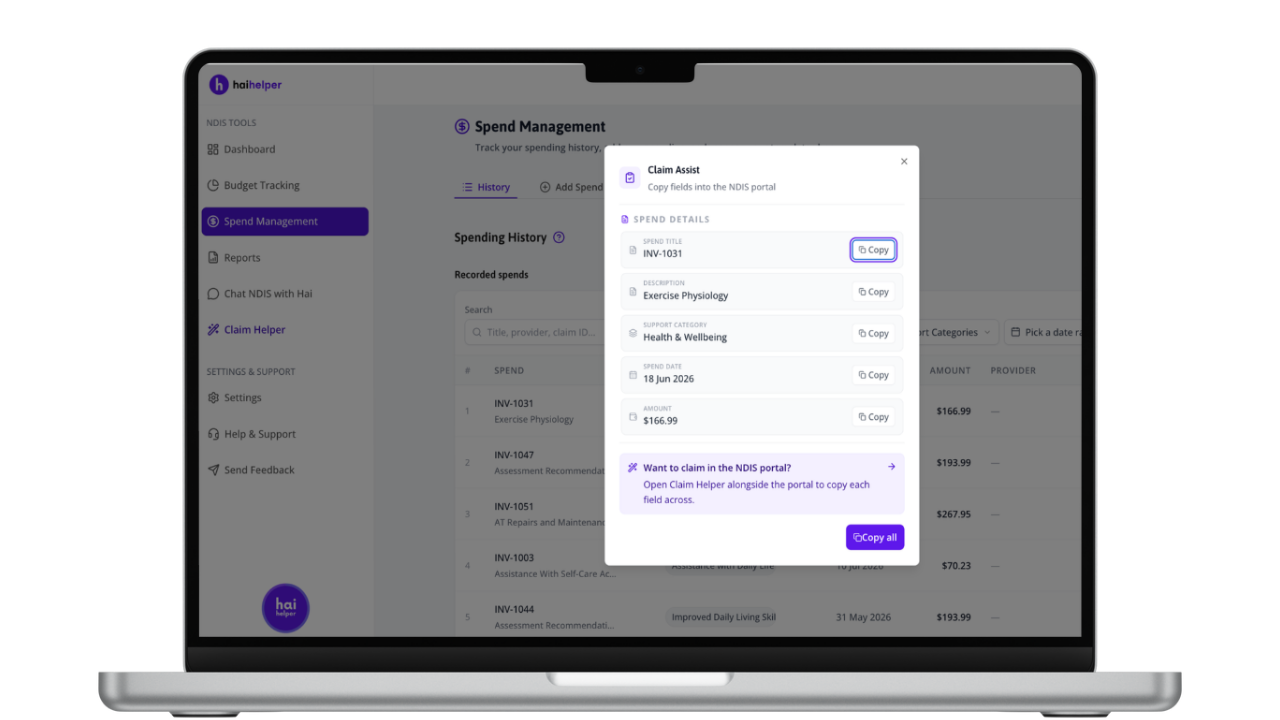
Hai Helper pulls out key details from your invoices to speed up the claiming process.
Want to claim faster? Upgrade coming soon
Budget tracking, plan understanding, an NDIS Companion to chat to, and claiming, all in one suite built specifically for Self-Managed NDIS participants.
Hai Helper sits as a connective layer between you and the NDIS, replacing the spreadsheets, folders, and guesswork most self-managed participants juggle daily.
Hai Helper pulls out key details from your invoices to speed up the claiming process.
Want to claim faster? Upgrade coming soon
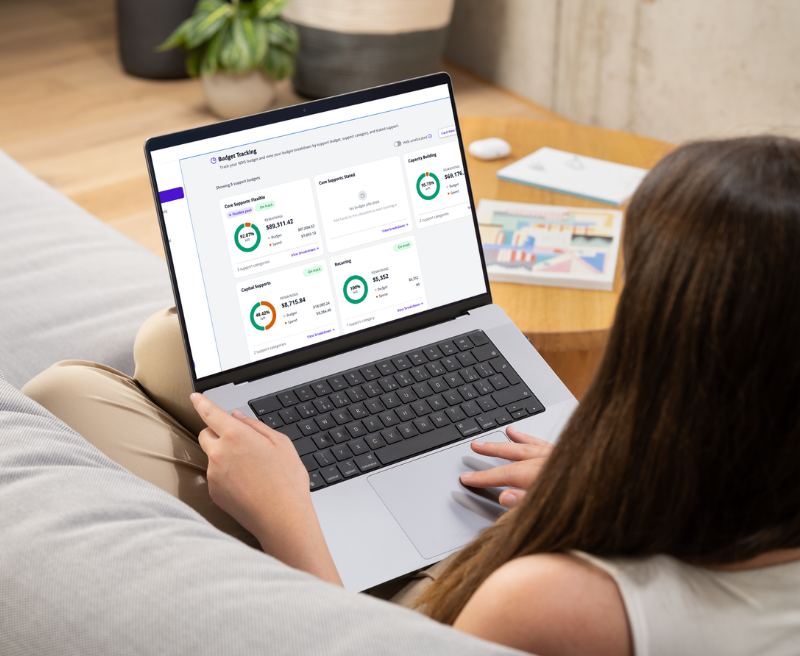
Simply tracks what you've spent against your plan, giving you forecasting insights and reports.
Connect invoices directly to your searchable spend records, so the paperwork stays where it belongs.
Full document storage coming soon
It draws on source information to help with everyday questions, or when you're preparing for a plan review.
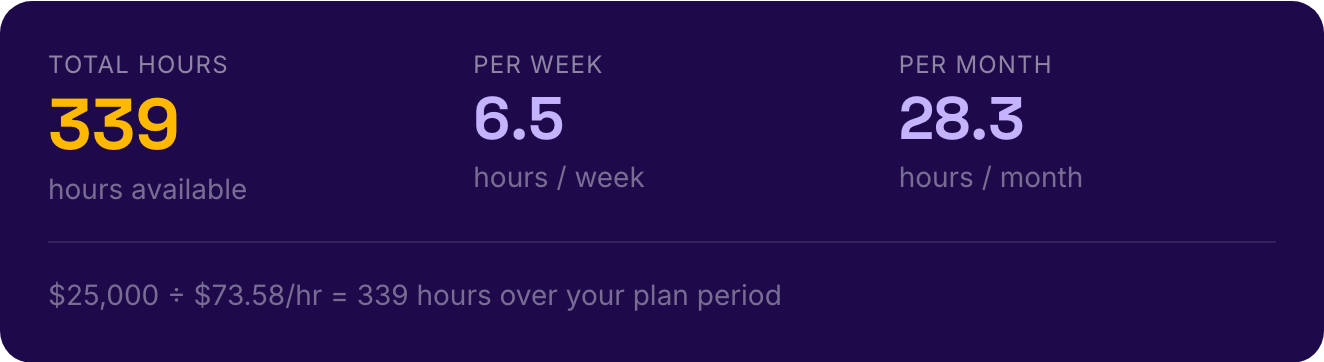
See what your budget means in real hours.
Enter your plan budget and support type to instantly see how many support hours you can access.
Running low? Find other funding options.
A quick, guided way to find other funding options when your NDIS budget for a service is running out.
Hai Helper isn't just a tool. It's a growing network of participants, carers, and advocates sharing knowledge and supporting each other.
“We need better tools, we need smarter tools, we need efficient tools to help us manage the day-to-day complexities of the NDIA and the NDIS.”
Andy — Self-managed Participant
Australia’s leading organisation for NDIS Self-Managers. Run by self-managers, for self-managers. Visit their site for resources, tools and up to date information on everything NDIS.

Visit selfmanagerhub.org.au
If reforms move you off the NDIS, or you never get on, where does support actually come from? A plain look at what's changing, what's coming, and what other doors exist right now.
The NDIS is a scheme for people with disability, yet its own operator admits parts of it don't meet accessibility standards. Here's what that gap costs, and why any tool in this space has to clear it first.
When most participants need a paid intermediary just to understand their own plan, the plan isn't readable enough. A look at the numbers behind the NDIS's understanding gap, and what actually closes it.
Agency-managed funding hasn't grown, it's shrunk. The money is drifting to the paid middle layer of plan management, and self-management is quietly getting harder to hold onto. Here's what the numbers actually show.
The government has announced sweeping NDIS reforms. Here is what is actually changing, what is still being designed, and what self-managed participants need to do right now.
A support worker is not just someone who assists with daily tasks, they are a partner in building capacity, achieving goals, and fostering independence.
Both exist to help you navigate the NDIS, but they serve very different purposes. Understanding who does what prevents funding surprises.
As a participant, you are a consumer with specific rights protected by both NDIS regulations and Australian law. Here's what that means in practice.
Self-management gives you total choice and control. With the right strategies and tools, it can be a highly rewarding and confidence-building experience.
There is an alternative vision for disability funding tech, one where AI serves as an empowering layer, amplifying human decision-making rather than replacing it.
With the right preparation, a plan review can be a powerful opportunity to advocate for your needs, not a source of anxiety.
The organisations best positioned to serve participants are those that build for empowerment from the ground up, not those that just process invoices.
Hai Helper is shaped by lived experience, allied health expertise, and a shared commitment to participant-first design.
Neurological physiotherapist turned founder. Driving product vision, funding strategy, business development, and community outreach, with deep first-hand knowledge of what NDIS participants actually need.
Mike Fairbairn
Business Strategy, Communications & Government Advisor
15+ years experience in media, government and policy adjacent positions
Anh Kim Phu
Accessibility Consultant & Community Advocate
Registered Accountant, Clinic Manager, NDIS participant
Andrew Turner
Accessibility Advisor & Community Advocate
Accountant for 25+ years, 10 years in not-for-profit space and advocacy roles, NDIS participant
Nick Hopkins & David Oram
Accessibility Tech Consultants & Developers
Collaboration with Atomic Web Strategy on WCAG Accessibility — atomicwebstrategy.com.au
1.3 billion people live with disability worldwide, most with no independent tool to manage or advocate for their own funded supports. Hai Helper starts with the NDIS, participant-led rather than provider-led, and that same approach is a blueprint for the world.
No. Only you can see your budget. Your data is private and stored safely on Australian servers.
It helps Hai Helper work better for you. You can see your NDIS funding clearly on your Dashboard. You can get answers about your funding in the Companion Chat. You can track what you spend and plan ahead so you do not run out of funds before your plan ends. Note that we do not save your NDIS number or any condition specific information. Hai Helper is built to help you navigate your funding and the system.
Your information is stored on AWS servers in Australia (the Sydney region). The Companion function, that involves AI, also runs on AWS in Australia (Amazon Bedrock) over a private network, so that your information processes onshore. Both storage and processing stay in Australia.
Hai Helper is made only for the NDIS. It uses current NDIS rules, laws, and guidelines to give you clear answers in plain English. It is not a general budget app. It is built for how the NDIS works.
You can request a copy of your data at any time. If you close your account, your data is deleted with your account under best privacy and data practices.
Anyone with an NDIS plan. It does not matter if you self-manage, use a plan manager, or have a mix of both. You can use Hai Helper to track your budget, upload invoices, and understand your funding. Some features are built for self-managed participants first. What you can access may depend on your plan type.
Hai Helper is a registered NDIS provider. Whether you can claim it depends on your own plan and goals, so it's always worth a quick check with your planner. Here's the general picture:
If you self-manage: you can pay for Hai Helper directly and claim it back yourself. It most likely sits as low-cost assistive technology for communication and information support, in your Core budget under Consumables. Depending on your goals it may also fit Capacity Building. Low-cost AT does not need a quote or an assessment.
If you're plan-managed: your plan manager pays Hai Helper for you. Ask them to claim it as low-cost assistive technology for communication or information support. They will confirm your budget covers it.
If you're NDIA-managed: because Hai Helper is now a registered provider, you may be able to claim it through the myID portal as low-cost assistive technology. Check with your planner or Local Area Coordinator that it fits your plan.
Need help asking? Use our Justification Letter Template (template only), fill it in and send it to your planner or plan manager.
Prefer to keep it simple? You can always just pay directly.
Hai Helper is not affiliated with the NDIA. This is general information, not NDIS or financial advice.
You upload your invoice. Hai Helper reads it and pulls out the key details you need, like the support item, provider, date, and amount. You then copy those details into the myNDIS portal yourself and submit the claim. Hai Helper does not submit claims for you. You stay in control of every step.
The Companion uses AI. AI can make mistakes. It is a helpful starting point but it is not a substitute for official NDIS advice. Always check important decisions with the NDIS, your support coordinator, or your plan manager. If something does not seem right, trust your instincts and ask a person.
Hai Helper cannot be quoted in a plan review. But it can help you get ready. The NDIS documents and links in the app can be used as evidence. Tracking your spending also gives you clear information about how you use your supports. That can help you make a stronger case at your review.
Yes. You can update your personal information and budget details any time in your Profile or Settings.
Hai Helper is built to be accessible. You can type or use your device's voice input to talk to the Companion. You can use screen readers and browser tools. Budget visuals use clear, high-contrast colours. Hai Helper also has a built-in help and support system you can access any time from inside the app. We meet WCAG 2.1 AA accessibility standards and we are working toward a higher level. If something is not working for you, please tell us. Your feedback helps us improve.
Hai Helper costs $14 per month or $120 per year, after a 1-week free trial. The yearly option saves you around three months compared to paying monthly. You can cancel any time. There are no lock-in contracts.
Not yet. Each account is for one person. Hai Helper runs through the official web app only. However, the chat can be used in-app without uploading a plan.
Join NDIS participants who are using Hai Helper to understand their budgets, exercise their rights, and live with more choice, control and power.
Your Funding Companion. Experience Clarity
NDIS pricing referenced from the current NDIS Pricing Arrangements and Price Limits. Hai Helper is not affiliated with the NDIA. Always confirm details with your plan manager or the NDIS.